
Art

William Mortensen: A Forgotten Master of Pictorialism in Photography

Champion of a Fading Artform Amid the Rise of Modernism

Share
231

The camera is an instrument that teaches people how to see without a camera. Dorothea Lange

William Mortensen (1897-1965) was one of the most renowned photographers in America during the 1930s working mainly in Southern California as a Hollywood and studio portrait photographer.He later passed on his methods to younger generations through teaching. Mortensen’s relative obscurity today stems largely from his advocacy for Pictorialism, a movement in photography that emphasized artistic techniques like retouching, hand-worked negatives, and chemical washes to achieve a painterly quality. However, with the rise of Modernism, Pictorialism soon fell out of favor. The influential photography periodical Camera Work (1903-1917), founded by Alfred Stieglitz, became a platform where the debate over “photography as art” took place, weighing the principles of Pictorialism against Modernism. When Camera Work published the photographic work of Paul Strand in its final issue, it marked the dominance of “straight photography”—an approach that emphasized sharp, unmanipulated images, especially with the development of faster lenses, reportage photography, and compact cameras.

Subscribe to our whatsapp channel!

William Mortensen
William Mortensen SLEEP c. 1930 Silver Gelatin Print

William Mortensen (1897–1965) FRAGMENT c. 1932
William Mortensen, Machiavelli.

William Mortensen, Belphegor
William Mortensen, Pit and the Pendulum
William Mortensen, The Priestess

William Mortensen, Death of Hypatia
William Mortensen, Circe

As Modernism overtook Pictorialism, Mortensen remained a passionate advocate, keeping the tradition alive through exhibitions, publications, and teaching, despite being viewed as an outsider by his contemporaries. Ansel Adams, a champion of the straight photograph, even described Mortensen as “the devil” and “the anti-Christ.” Over time, photographic history largely favored Adams’ perspective, leading to Mortensen’s marginalization. For Mortensen, photography, like any art form, was a form of communication. He believed art should be clear in its message, that it communicated ideas rather than objects, and that it relied on symbolic language to convey meaning.

William Mortensen, Venus and Vulcan
William Mortensen, The Heretic

William Mortensen, A Tantric Sorcerer
William Mortensen

William Mortensen SALOME c. 1930 Silver Gelatin Print
William Mortensen Title unknown

William Mortensen "Jean"
William Mortensen "L'Amour"

William Mortensen’s work occupies a fascinating, if controversial, space in the history of photography. As a champion of Pictorialism during a time when Modernism was gaining dominance, his artistic approach was often at odds with the photographic trends of his day. Mortensen’s use of heavily retouched negatives, theatrical compositions, and imaginative, sometimes grotesque subject matter, positioned him as an anomaly in an era that began to favor realism, clarity, and unmanipulated imagery. While his techniques may have seemed out of step with the emerging ethos of “straight photography,” Mortensen’s mastery of craft and his distinct vision demand closer reconsideration.

William Mortensen "The Mirror"
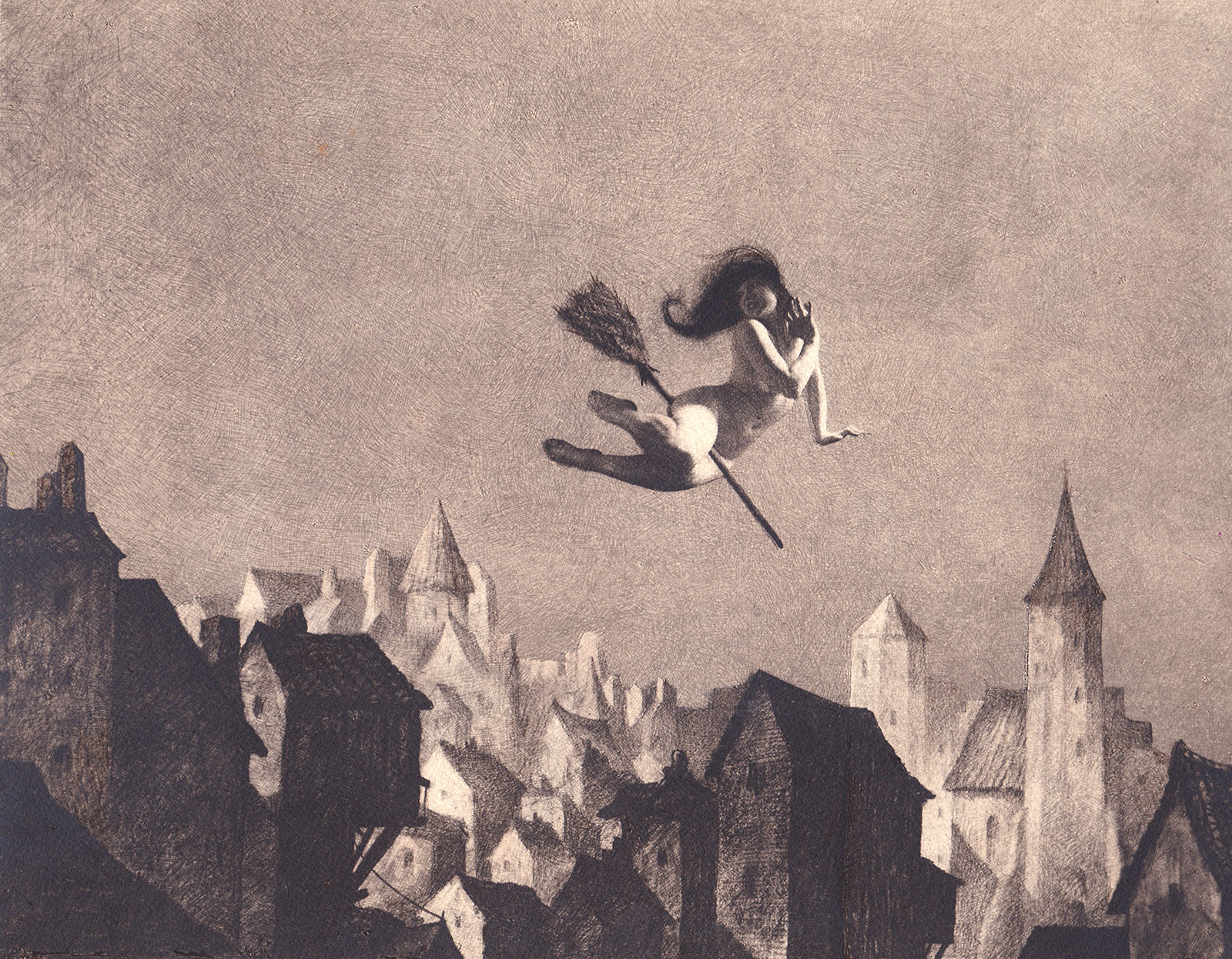
William Mortensen "Preparation For The Sabbath"
William Mortensen Title unknown (Saint Courtney)

William Mortensen "Mort De Guillaume"
William Mortensen "Adelita"

One of the most striking aspects of Mortensen’s work is his insistence on photography as an interpretive, rather than purely documentary, medium. His images are rich with symbolic content, evoking allegory, myth, and fantasy. Mortensen’s portraits, in particular, exhibit a keen sense of drama, employing carefully arranged lighting and set design to heighten emotional intensity. Rather than striving for photographic realism, he embraced the artificial, the theatrical, and the surreal, turning photography into a medium of illusion and storytelling.

William Mortensen "Wind"
William Mortensen "Fear"
William Mortensen "Anna Mae Wong"

William Mortensen "An Indian Lyric"
William Mortensen "Nude Study"

William Mortensen
William Mortensen

However, Mortensen’s reliance on hand-worked techniques and elaborate retouching was, for many of his contemporaries, precisely the problem. Critics argued that his methods, which blurred the line between photography and painting, undermined the mechanical purity of the camera as an objective tool. Ansel Adams, a vocal critic, derided Mortensen’s work as excessive and outdated, viewing it as a distraction from the “truth” that modern photography could reveal through unaltered images.

William Mortensen "Thunder"
William Mortensen "Nude Study"

William Mortensen
William Mortensen "Vigne"

William Mortensen "Youth"
William Mortensen "Zaida"
Untitled c 1926 - 1927 from the series "A Pictorial Compendium of Witchcraft

Yet, to dismiss Mortensen as merely a relic of an earlier era would be a mistake. His commitment to craft, his exploration of psychological depth, and his willingness to challenge the boundaries of what photography could be—long before the digital manipulation we see today—make him an artist ahead of his time in some respects. Mortensen’s vision, while not universally accepted, reflects a broader understanding of photography as an art form capable of conveying ideas, emotion, and mystery, rather than merely recording reality. His legacy, often overshadowed by the rise of Modernism, is deserving of renewed appreciation for its boldness and originality.

The Mark of the Borgia, ca. 1930
William Mortensen "Sappho The Supreme and Melancholy Poetess of Old Greece"
William Mortensen

William Mortensen "A Hindoo Woman"

mediastaff
Author: mediastaff

231

Leave a comment

Leave a Reply

Related Articles
ArtCultural IconsNaturePaperSustainable

Story Of a Lily In 10 Poses (The Ortolan Lily 2025)

The 2025 edition of Nola’s Festa dei Gigli, an intangible heritage of...

ArtIllustration

Shaun Tan: The Art of Storytelling Without Words

Shaun Tan (born 1973) is an acclaimed Australian artist, writer, and filmmaker...

ArtDrawing

Anders Zorn: The Swedish Painter Who Conquered the Art World

[lwa template=”Modal” registration=”1″] Life itself is the first, the greatest, of the...

Explore Arteide across the globe

The Arteide Magazine is the new point of reference for exploring the vast world of art and culture. Your daily dose of inspiration, astonishment and information.

Terms of Service and Privacy Policy